
You’re at the cookout. Someone pulls out sunscreen and suddenly everybody’s a comedian.
“Girl, we don’t need that.”
“Black don’t crack!”
“That’s for white people.”
Sound familiar? If you’ve ever laughed along — or quietly put the bottle away to avoid the commentary — this article is for you.
We’ve been passing this belief down for generations, and honestly? It makes sense that the myth took root. Our melanin-rich skin is resilient. We do burn less. And for decades, the medical community didn’t do enough to tell us otherwise — more on that later.
But the question on the table is: Do we need to use sunscreen?
The answer is a resounding YES– and there are a few things that make it a little more complicated than that.
Medical researchers have continuously explored sun exposure as a risk factor for skin cancer since the changes in the atmosphere during the 70s. The data about how those changes affect dark-skinned people hasn’t always reached us, though — and that gap in information has created myths we’ve treated as fact. It’s time to change that.
A Harmful Myth: Having Dark Skin Makes You Immune to Sunburns
You’ve heard it. Maybe you’ve said it: your dark skin makes you immune to sunburns. It’s true that the higher pigment levels that give your skin its depth and richness help protect against sunlight — but they don’t make you immune to it.
The research backs it up.
A 2010 survey in the United States showed that 13% of Black women and 9% of Black men reported getting at least one sunburn in the last 12 months. This trend continued until 2015, when it was last reported.
The sun doesn’t discriminate. It burns all types of skin equally; including those that are melanin-rich like yours.
Even dark-skinned people are not 100% protected. Sunburn on deeper skin tones can show up as tenderness, swelling, pain, and in cases of heavy exposure — blistering or darkening of the skin. Excessive sun exposure can also cause diffuse hyperpigmentation and even visible signs of aging earlier than expected.
**And here’s what matters for us specifically:** For Black women dealing with hyperpigmentation, uneven skin tone, or dark spots — sun exposure doesn’t just cause new damage, it makes existing damage *worse*. UV rays deepen post-inflammatory hyperpigmentation (PIH), those stubborn dark marks left behind by acne, cuts, or irritation. No serum or treatment works as well as it should if you’re not protecting your skin from the sun first.
These conditions are frustrating enough on their own — but they’re still not the most serious concern. Lesions caused by excessive sun exposure are also linked to skin cancer.
Wait, I Thought My Dark Skin Also Made Me Immune to Skin Cancer Too?
As lovely as that would be, dark skin does not make you resistant to skin cancer. Anyone, regardless of skin color, can develop it. “Cancer-resistant skin” is a myth — one the numbers have quietly reinforced.
Studies showed a lower incidence of skin cancer among Hispanic and Black people between 1990 and 2004.
Out of 41,072 melanoma cases, the study reported 1,148 for Hispanics and 254 for African Americans. At first glance, that seems reassuring. But here’s what those numbers actually mean: skin cancer is less diagnosed in Black communities — not less prevalent.
Be Careful
Skin cancer in people of color is likely to be caught at a more advanced stage. And a late diagnosis has serious consequences — including higher mortality rates.
This is exactly why the myth is dangerous. It doesn’t just affect our skincare routines — it affects how seriously we take symptoms and how quickly we seek care.
But where did the Myth Come from?
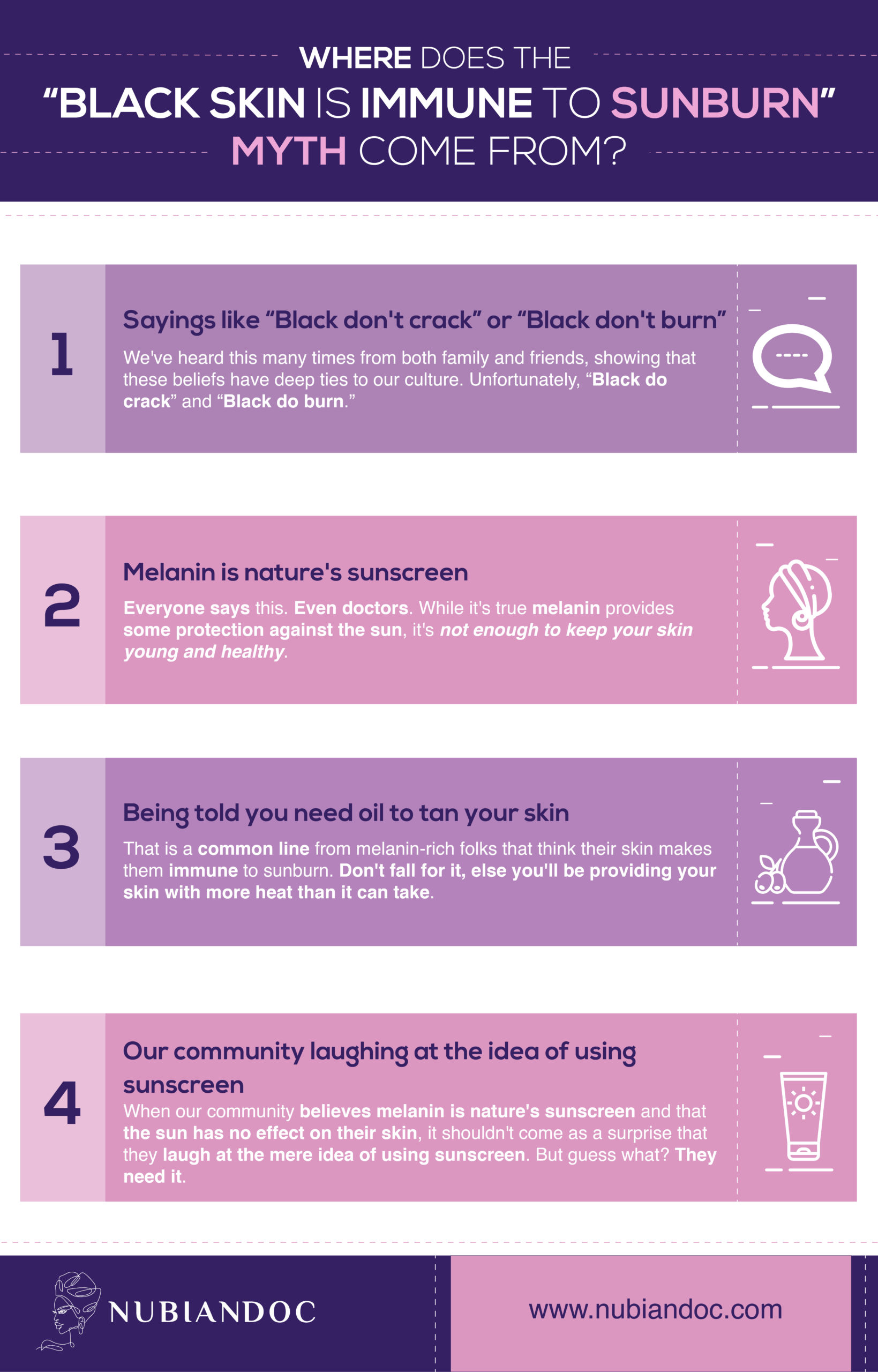
It’s easier to ask who didn’t perpetuate it. Here’s what you’ve probably heard:
“Black don’t crack”
“Melanin is nature’s sunscreen”
“At the beach? Take oil, not SPF”
“Sunscreen!? Girl…”
These aren’t just sayings — they conditioned an entire community to believe our skin doesn’t need protection. But our community isn’t alone in this. The medical system played its part too.
To this day, many physicians believe that Black or dark-skinned people don’t need sunscreen. A 2014 study found that for every 100,000 Black patient visits, only 26 were prescribed sunscreen — nearly ten times less than white patients received.
Is it Neglect or Ignorance?
The honest answer is: both have played a role. But a major factor is that the medical field has historically underinvested in studying the effects of sun exposure on darker skin.
A 2011 survey found that 47% of dermatologists and dermatology residents felt their training hadn’t adequately prepared them to treat and identify skin conditions in people of color.
If your doctor has never mentioned sunscreen to you — you are not alone. And that is not your fault. That gap in care is exactly why spaces like NubianDoc exist.
Luckily, we’re here to tell you: sun immunity is NOT real. So if we’re not immune — what are we?
Resilient, Not Immune:
Resilience is the word. Our skin is extraordinary — but extraordinary doesn’t mean invincible.
Skin cancer risk varies by skin type, and the Fitzpatrick Skin Type Classification System gives us a framework for understanding how different skin responds to UV exposure:
The Fitzpatrick Skin Type Classification System:
- Skin type I: Always burns, never tans, sensitive to ultraviolet exposure
- Skin type II: Burns easily, tans minimally
- Skin type III: Burns moderately, tans gradually to light brown
- Skin type IV: Burns minimally, always tans well to moderately brown
- Skin type V: Rarely burns, tans profusely to dark
- Skin type VI: Never burns, deeply pigmented, least sensitive
Most Black women fall into Types V and VI — which means our skin is more resilient. Just not immune.
A note on this scale: The Fitzpatrick system was originally developed using white patients, and it has real limitations when it comes to capturing the full spectrum of darker skin tones. It’s a useful starting point — not the full picture.
Melanin — What It Actually Does (And Doesn’t Do)
Melanin is the natural pigment responsible for your skin’s color. It’s produced by cells called melanocytes, and your body makes it as a protective response to sun exposure. All people have roughly the same number of melanocytes — what differs is the size and distribution of melanosomes, which produce melanin and give darker skin its depth.
Does My Melanin-Rich Skin Protect Me from the Sun?
Yes — and it’s significant. People with skin types IV–VI can withstand UV rays better than those with lighter complexions. We feel less, and burn less.
But here’s the crucial distinction: UV rays are five times less potent against Black skin — however, melanin still doesn’t offer significant protection to the basal cells against UV radiation.
In plain language: the damage happening beneath the surface of your skin isn’t always visible on top. You may not see a sunburn — but UV radiation is still affecting your skin at the cellular level.
I can’t stress this enough: Take care of your skin. There isn’t such a thing as sun immunity.
Skin Cancer in Skin of Color
The three most frequently diagnosed skin cancers in African Americans are::
1. Squamous Cell Cancer
The most common skin cancer among African Americans, squamous cell carcinoma starts in the outermost layer of the skin and tends to occur in sun-exposed areas.
2. Basal Cell Carcinoma
The second most common skin cancer in African Americans, it begins in basal cells — those responsible for producing new skin as old cells die — and primarily affects people with significant sun exposure.
3. Melanoma
Melanoma starts in melanocytes and is linked to UV radiation. It’s responsible for 75% of all skin cancer deaths. Though rare in African Americans, it has a worse prognosis for people of color than for Caucasians.
It can also appear in areas with less melanin — like under your nails, on the palms of your hands, or the soles of your feet. This is called acral lentiginous melanoma — the type Bob Marley was diagnosed with, found beneath his toenail.
All three of these skin cancers can result from regularly exposing unprotected skin to UV radiation. That’s the thread that connects them — and the reason sunscreen matters.
Dark-Skinned People NEED Sunscreen
Sun protection goes a long way to prevent you from developing life-threatening skin conditions. In a world where just five sunburns can increase your risk of getting skin cancer, it’s best to take measures that’ll rid you of that concern. By now, we’ve learned that exposing your unprotected skin to the sun can result or potentially result in:
- Uncomfortable sunburns
- Premature aging
- Tanning, Dark Spots and Hyperpigmentation
- Worsening of post-inflammatory hyperpigmentation (PIH)
- Skin cancer
Sunscreen works by increasing your skin’s natural protection from UV rays — acting as an added shield on top of what your melanin already provides.
Dark Skin Has a Natural Skin Protection Factor?
Yes. African Americans have a natural SPF of up to 13 thanks to melanin, filtering roughly twice as much UV radiation as lighter skin. That’s meaningful.
But it’s not enough.
The American Academy of Dermatology recommends SPF 30 at minimum, which blocks 97% of UV rays. An SPF of 13 leaves significant protection on the table.
“But Sunscreen Leaves a White Cast…” — Let’s Talk About That
This is the most common reason Black women skip sunscreen — and it’s a completely valid concern. For years, the only widely available options were thick mineral formulas (zinc oxide, titanium dioxide) that left an obvious white or purple cast on deeper skin tones. That’s a real barrier, and it’s one the industry is finally addressing.
Here’s what to look for:
- Chemical sunscreens (avobenzone, octinoxate) absorb into the skin and typically don’t leave a cast
- Tinted mineral sunscreens are formulated to blend into deeper skin tones
- Mineral sunscreens labeled “sheer” or “invisible” use micronized particles that reduce the white cast significantly
- Black-owned and melanin-focused SPF brands have emerged specifically with our skin in mind
SPF 30 or higher, broad-spectrum (protecting against both UVA and UVB rays), applied daily — that’s the standard. And yes, even on cloudy days. Even when you’re mostly indoors.
Are There Any Other Ways to Protect My Skin?
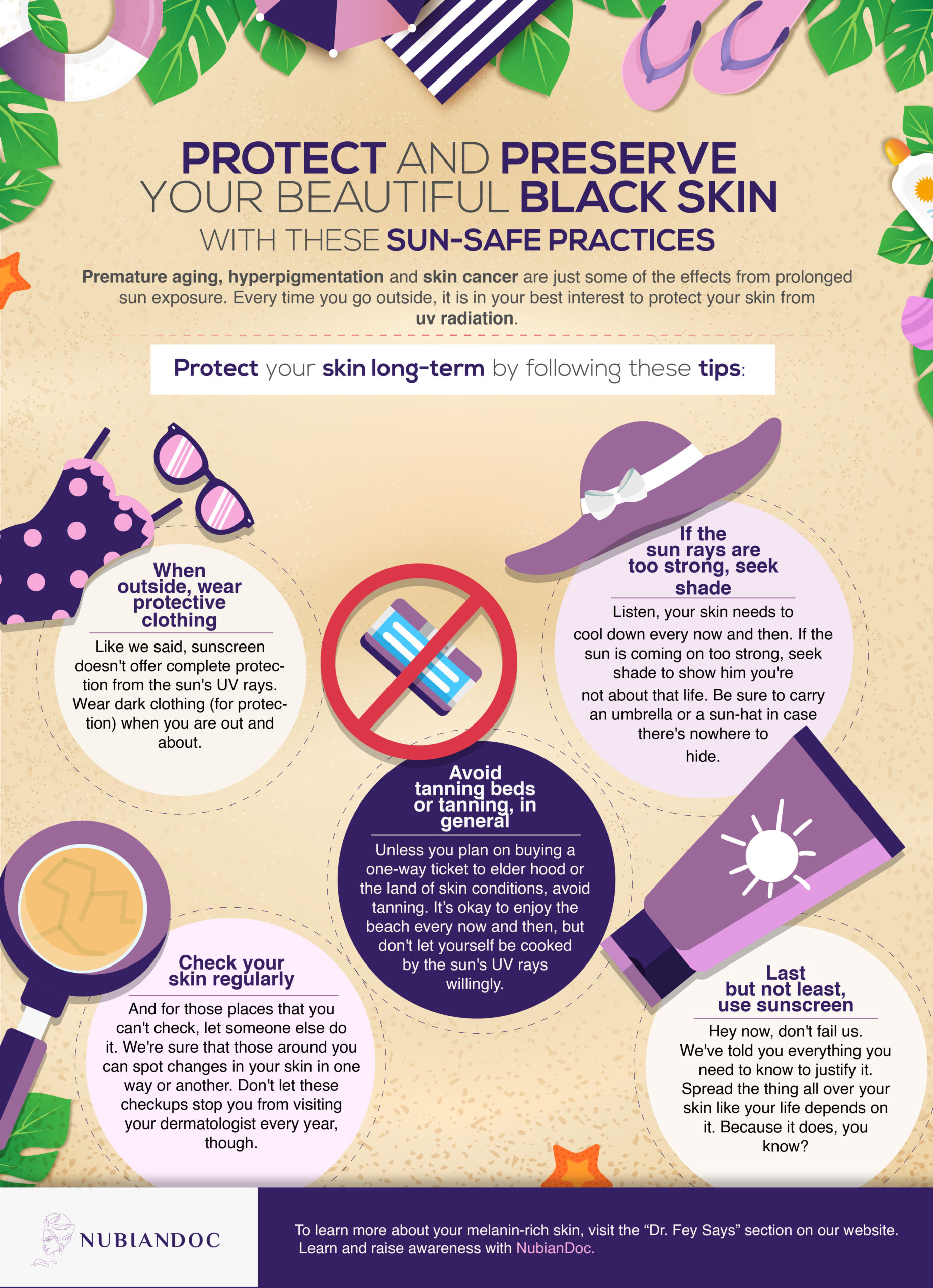
Sunscreen is your foundation, but it works best alongside these habits:
- Seek shade during peak sun hours — typically 10am to 2pm
- Avoid tanning beds — they emit UV rays that harm skin regardless of skin tone
- Wear protective clothing — dark clothing helps filter additional UV exposure
- Check your skin regularly — note any new growths, or changes in existing moles, freckles, or spots
- Visit your doctor if anything looks new, unusual, or changing — don’t wait
The Bottom Line
Your melanin is powerful. It is not a substitute for sunscreen.
The myth that dark skin doesn’t need protection didn’t come from nowhere — it came from a medical system that wasn’t designed to see us, and a community doing the best it could with what it was told. Now you know better. And now you can do better.
Did you find this article helpful? Have a topic you want us to cover? Reach out here. And subscribe to our newsletter for health guidance made with you in mind.
