

If your period is so heavy that you plan your schedule around it — the clothes you wear, the meetings you avoid, the bathrooms you map out — that is not something you should have to simply accept.
For many Black women, these symptoms are caused by uterine fibroids: non-cancerous growths that develop in or around the uterus.
Fibroids are extremely common, and Black women experience them at higher rates, often developing them at younger ages and experiencing more severe symptoms. Yet many women spend years being told that heavy bleeding, pelvic pain, exhaustion, or pressure are “just part of being a woman.”
They are not.
Your symptoms deserve evaluation. Your treatment options deserve discussion. And understanding what exists before you walk into your appointment can change the conversation.
This guide explains:
- What fibroids are
- The symptoms that should not be ignored
- Why Black women are disproportionately affected
- Treatment options beyond hysterectomy
- The questions to ask your healthcare provider
Quick Takeaways
- Uterine fibroids affect a large percentage of women, with Black women experiencing higher rates and often more severe disease.
- Heavy periods, pelvic pressure, urinary symptoms, and unexplained fatigue can be signs of fibroids.
- Fibroids are treatable, and hysterectomy is not the only option.
- Newer medications such as Myfembree and Oriahnn provide additional non-surgical treatment options for some patients.
- Being informed helps you advocate for care that matches your symptoms, goals, and preferences.
What Are Uterine Fibroids?
Uterine fibroids, also called leiomyomas, are benign (non-cancerous) growths made of muscle and fibrous tissue that develop in or around the uterus.
They can range from very small growths to masses large enough to enlarge the uterus significantly. Some women have one fibroid. Others have multiple.
Where a fibroid grows often matters as much as its size.
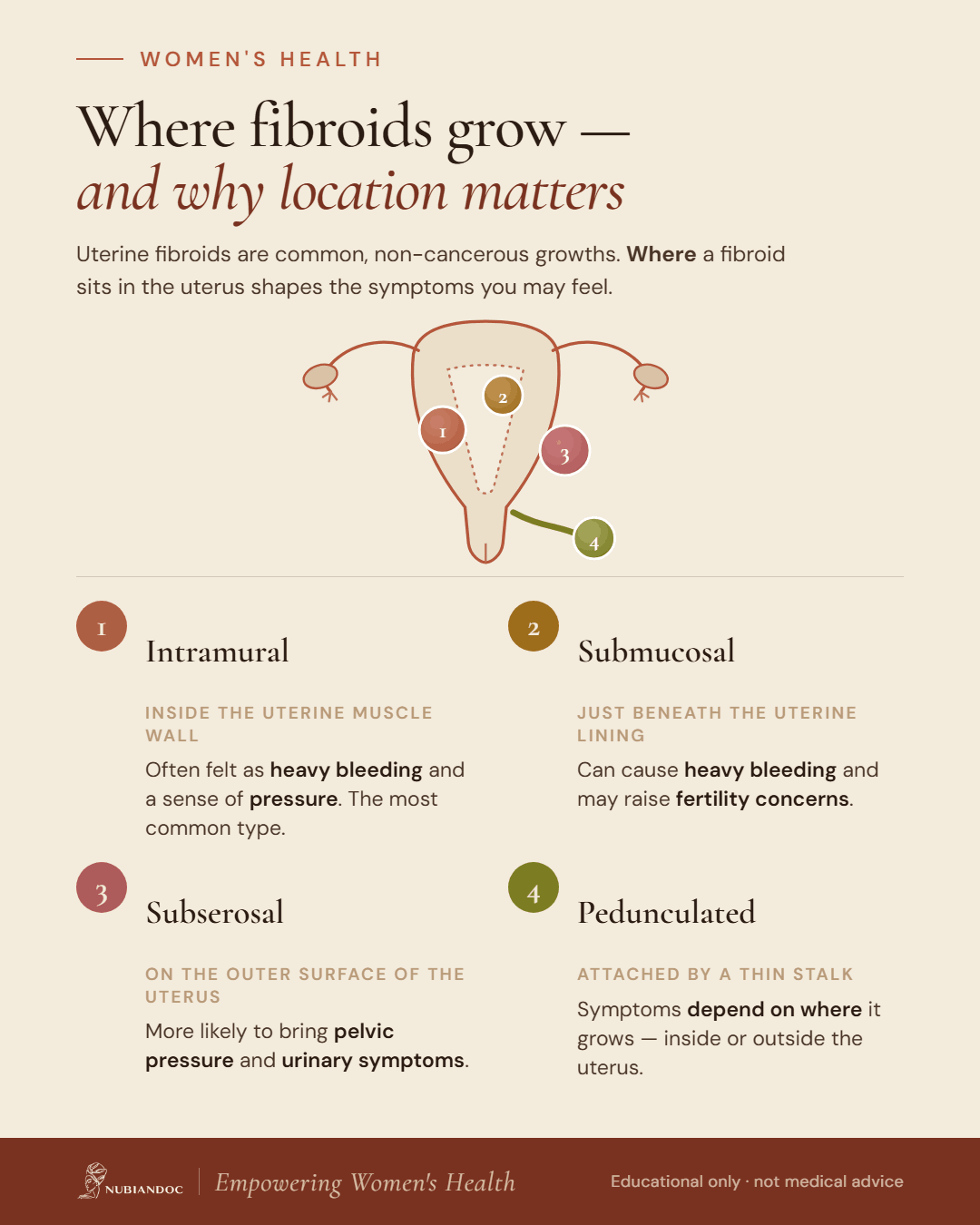
Types of Fibroids
Intramural fibroids
Grow within the muscular wall of the uterus and are the most common type.
Submucosal fibroids
Grow beneath the inner lining of the uterus and are strongly associated with heavy menstrual bleeding.
Subserosal fibroids
Grow on the outside of the uterus and may cause pressure, bloating, urinary symptoms, or constipation.
Pedunculated fibroids
Attach to the uterus by a stalk and can grow internally or externally.
Understanding location helps explain symptoms and guides treatment decisions.
Symptoms That Should Not Be Normalized
Many women adapt to symptoms that significantly affect their quality of life because they have been told they are “normal.”
Heavy bleeding is common. That does not mean it should be ignored.
Heavy Menstrual Bleeding
Signs include:
- Soaking through pads or tampons frequently
- Passing large blood clots
- Bleeding longer than expected
- Missing activities because of your period
Over time, heavy bleeding can lead to iron deficiency and anemia.
This may cause:
- Fatigue
- Brain fog
- Shortness of breath
- Rapid heartbeat
- Feeling exhausted despite adequate sleep
Sometimes women are treated for anemia repeatedly without the underlying cause of blood loss being investigated.
Pelvic Pressure and Pain
Fibroids can press against surrounding organs, causing:
- Pelvic fullness or heaviness
- Abdominal enlargement or bloating
- Frequent urination
- Difficulty emptying the bladder
- Constipation
- Lower back discomfort
Fertility and Pregnancy Concerns
Depending on location, fibroids may affect:
- Fertility
- Implantation
- Pregnancy outcomes
A small fibroid in one location may have little impact, while another fibroid affecting the uterine cavity may be more significant.
Why Are Fibroids More Common in Black Women?
The reason is complex.
Research suggests that fibroid risk is influenced by multiple factors, including genetics, hormonal factors, environmental exposures, stress physiology, and differences in healthcare experiences.
Black women are more likely to:
- Develop fibroids earlier
- Have larger or more numerous fibroids
- Experience more severe symptoms
- Undergo certain procedures at higher rates
Researchers are still studying the full picture, but one thing is clear:
Fibroids are not just an individual health issue. They are also a women’s health equity issue.
The Healthcare Gap: When Symptoms Are Not Taken Seriously
Many Black women describe experiences where symptoms were minimized or attributed to other causes before fibroids were diagnosed.
This matters because delayed diagnosis can mean:
- Larger fibroid burden
- More severe anemia
- Fewer treatment choices
- More invasive procedures
The goal is not to create fear about healthcare. The goal is to enter medical conversations informed.
You deserve a provider who listens, explains your options, and considers your goals.
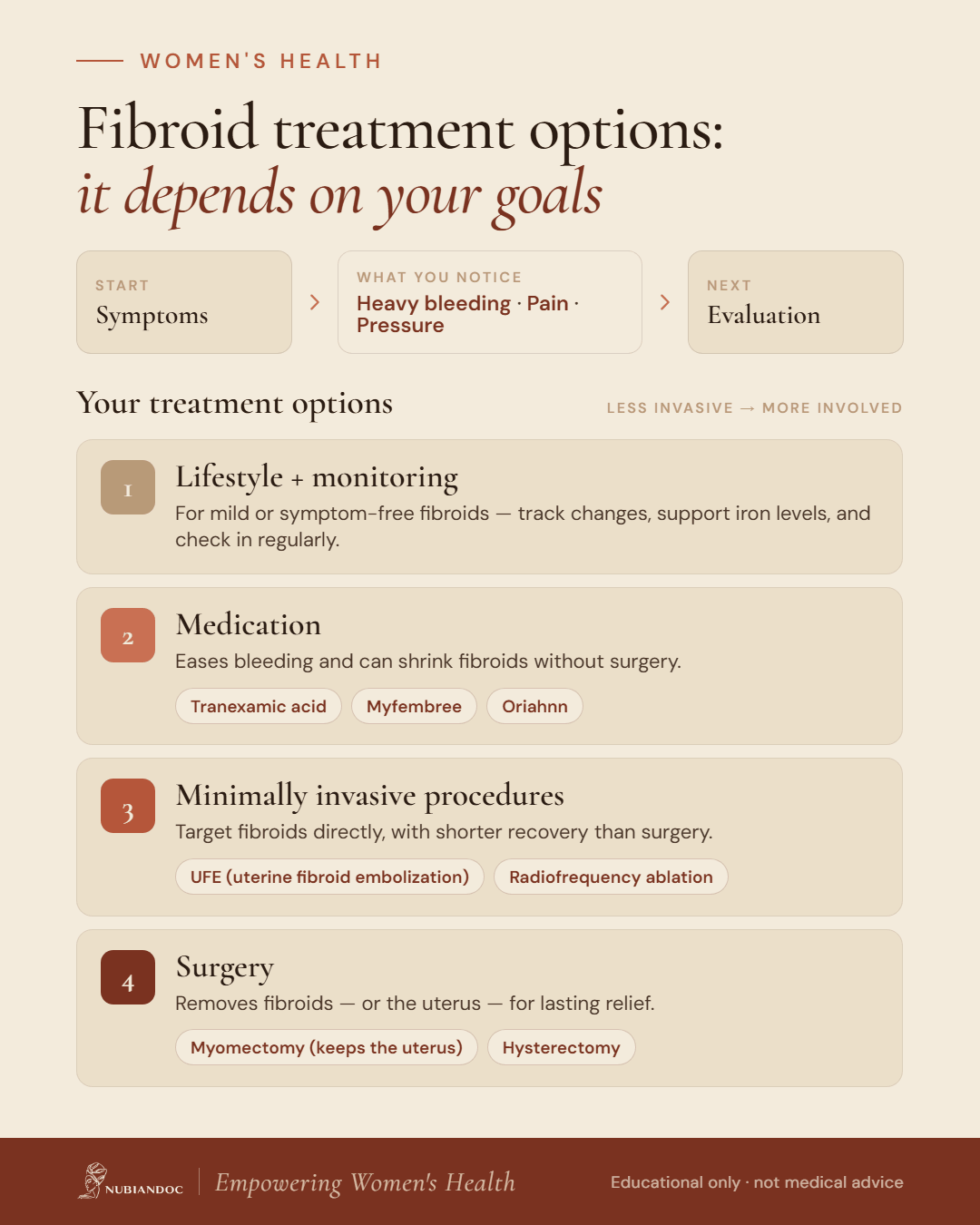
Treatment Options for Fibroids
Treatment depends on:
- Your symptoms
- Fibroid size and location
- Age
- Fertility goals
- Overall health
Monitoring
If fibroids are small and not causing symptoms, monitoring may be appropriate.
Not every fibroid requires immediate treatment.
Medications
Iron Supplementation
If heavy bleeding has caused iron deficiency, correcting low iron is important.
Ask about checking:
- Hemoglobin
- Ferritin (your stored iron level)
Tranexamic Acid (Lysteda)
A non-hormonal medication taken during your period that can reduce heavy bleeding.
It does not shrink fibroids but may improve symptoms.
Hormonal Options
These may include:
- Birth control pills
- Progestin medications
- Hormonal IUDs such as Mirena
These can reduce bleeding but generally do not eliminate fibroids.
Myfembree and Oriahnn
Newer oral medications offer another option for some women with fibroid-related heavy bleeding.
They work by changing hormone signals involved in fibroid growth while using “add-back” hormones to reduce side effects.
They are not appropriate for everyone, so your medical history matters.
Procedures That Preserve the Uterus
Uterine Fibroid Embolization (UFE)
UFE blocks blood flow to fibroids, causing them to shrink.
Benefits:
- Minimally invasive
- Shorter recovery than many surgeries
- Preserves the uterus
Fertility considerations should be discussed individually.
Radiofrequency Ablation
Uses heat to destroy fibroid tissue.
Some procedures can be performed without traditional surgery.
Surgery
Myomectomy
Removes fibroids while preserving the uterus.
Often considered for women who want future pregnancy, depending on circumstances.
Hysterectomy
Removes the uterus and is the only permanent cure for fibroids.
For some women, it is absolutely the right option.
The important question is not whether hysterectomy is “good” or “bad.”
The question is whether you understand all appropriate options before making that decision. Notably, Black women undergo hysterectomy for fibroids at disproportionately higher rates, which makes understanding uterus-preserving options especially important.
Questions to Ask at Your Appointment
Consider asking:
- What type, size, and location are my fibroids?
- How are my symptoms connected to my fibroids?
- What treatment options fit my goals?
- Am I a candidate for medication, UFE, or myomectomy?
- How would treatment affect fertility?
- Are we treating the cause of my symptoms or only managing the consequences?
If You Feel Your Concerns Are Being Dismissed
You can say:
“I would like to better understand all treatment options available for my fibroids, including uterus-preserving options.”
You can also ask:
“Can we document my symptoms and discuss a referral to a gynecologist who specializes in fibroid care?”
Advocating for yourself is not being difficult.
It is participating in your healthcare. Community organizations such as The White Dress Project offer support and education for women living with fibroids.
The Bottom Line
Fibroids are common. But suffering through heavy bleeding, pain, and exhaustion should not be considered normal.
Black women experience a disproportionate burden of fibroid disease, and knowing your symptoms and options can help you have more informed conversations with your healthcare team.
The treatment landscape is changing. More medications and minimally invasive procedures are available than ever before.
The first step is knowing what questions to ask.
At NubianDoc, our mission is to provide physician-written health education that helps women understand their bodies, recognize symptoms, and make informed healthcare decisions.
Because your health deserves to be understood — not dismissed.
Sources & Further Reading
- NIH (NICHD) — Uterine fibroids and health disparities
- Fertility and Sterility — Systematic review on fibroids and fertility
- American Journal of Obstetrics & Gynecology — The fibroid crisis (2024)
- Racial disparities in surgical outcomes for uterine fibroids — Systematic review (2025)
- PMC — Racial disparities in hysterectomy for fibroids
- Women’s Health Issues — Intersectional invisibility (2025)
- PMC — Research on pain dismissal in women’s healthcare
- ACOG — Uterine fibroids patient education
- The White Dress Project
